




Commercial · Rooftop units
Rooftop unit service and repair in Montreal
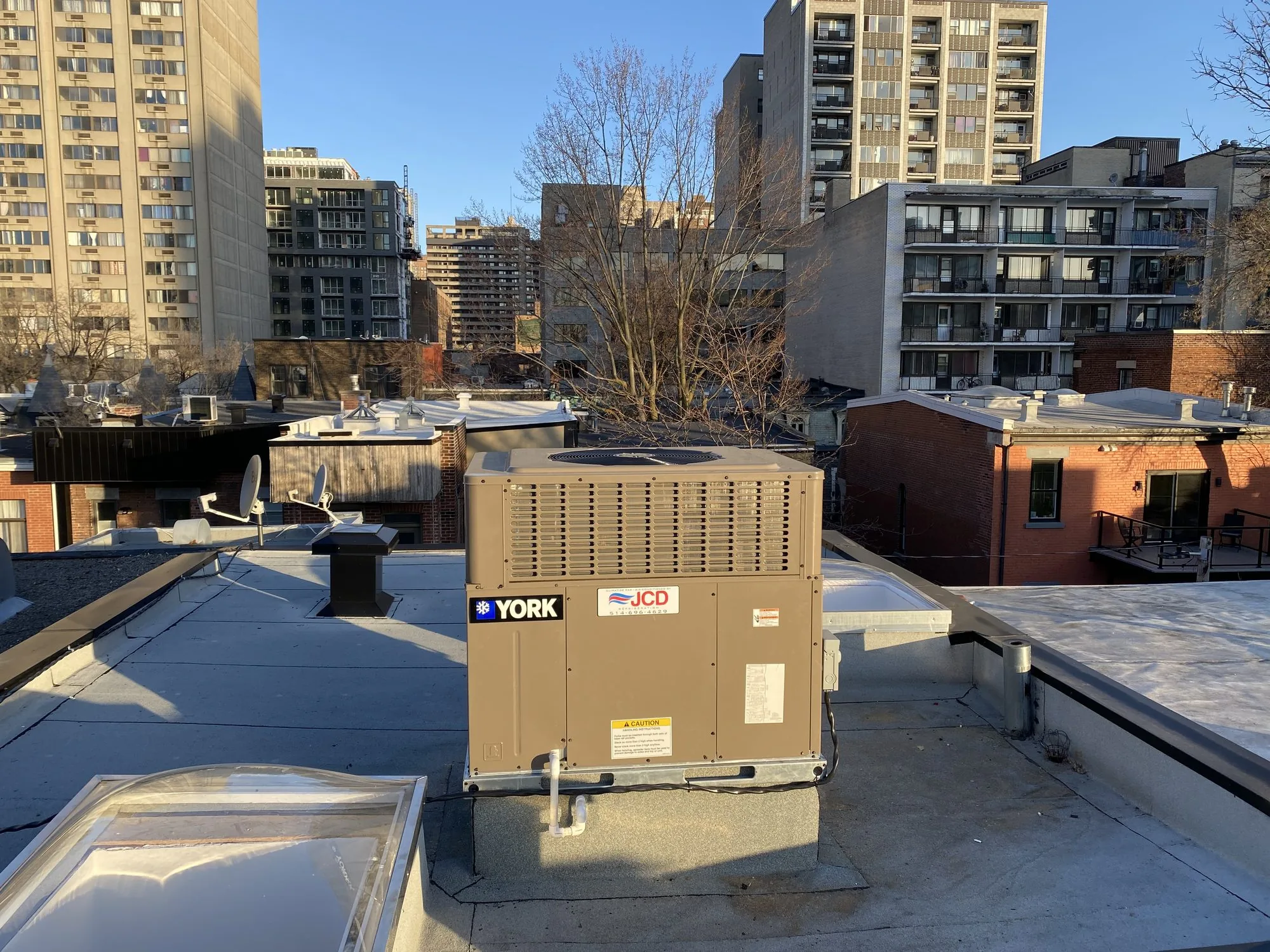
Repairs, replacement and preventive maintenance for packaged rooftop heating and cooling systems from 2 to 40 tons. We service all brands, document equipment condition and completed work, and coordinate service with your building’s operations.


- 24/7Emergency service
- Maintenance agreementsScheduled service for your equipment
- 2–52 visitsPer year, per unit under scheduled maintenance
- Service reportsFindings and completed work documented by unit

Rooftop unit services
Six areas of commercial RTU workDiagnosis and repair

We test the electrical, heating, cooling, airflow and control systems to identify the cause of the problem. Relevant readings and findings are documented on the service report.
Compressors and coils
Compressor, condenser-coil, evaporator-coil, expansion-valve and related cooling-circuit repairs. Work is pressure tested, evacuated and commissioned according to the equipment requirements.
Economizers and controls
Diagnosis and repair of damper actuators, outdoor-air sensors, thermostats, control boards and BAS connections.
Belts, bearings and motors
Inspection and replacement of belts, bearings, pulleys, blower components and fan motors. Alignment and airflow are checked before the unit is returned to service.
Cabinet and drainage
Repair of damaged panels, seals, drain pans and condensate components. Roofing, curb or flashing work is coordinated with the appropriate trade when required.
Rooftop-unit replacement
Equipment selection, crane coordination, curb adaptors, rigging and connection of the new unit. Gas, electrical, controls and related trades are coordinated as part of the replacement plan.
Typical rooftop-unit service costs
Montreal and the West Island · Updated September 2026Actual cost depends on equipment capacity, required parts, rooftop access, crane requirements and related electrical, gas or control work.
After the unit is diagnosed, we explain the required repair and provide the price for approval before repair work begins.

Questions buyers ask
We recommend four maintenance visits per year to check operation, service filters and prepare the equipment for seasonal changes. Units exposed to heavy dust or demanding operating conditions may need more frequent attention. We tailor the schedule to your equipment and how it is used.
For service, yes. For a changeout, almost never: a packaged unit needs a lift, and we schedule the crane and the road occupancy permit as part of the job rather than leaving it to you.
Remaining life per unit, refrigerant type, and what has to be spent in the next three budget years. It is the document that turns a surprise into a line item.
Yes. We service all HVAC brands, whoever installed the equipment.
Usually yes. We coordinate timing with your team in advance, which can include a weekend or evening when preferred. A single-zone unit is out and back in the same day if the crane window holds.
It is quoted as a line item, depending on reach and street closure. Multiple units on one lift share the cost.
An adapter where the footprint is close and the roof membrane is sound. A new curb where it is not, because an adapter over a bad curb leaks.
Yes, and we check them. A stuck economizer is the most common reason a building heats and cools in the same hour.
Refrigerant compliance, documented
Quebec Halocarbon RegulationBuilding owners remain responsible for regulatory compliance. We support that responsibility with qualified technicians, documented refrigerant handling and clear service records for every applicable unit. Quebec requires specialized halocarbon work to be performed by appropriately qualified people.
| Requirement | What we do | Frequency |
|---|---|---|
| Leak testing | Test for leaks when equipment conditions or regulations require it, record the findings and identify any corrective work. | As required |
| Equipment records | Document the unit, refrigerant type, quantities added or recovered, work completed and technician findings. | Each applicable intervention |
| Qualified handling | Refrigerant work is completed by technicians holding the required environmental qualification. Refrigerant is recovered using approved procedures. | Every applicable service call |
| Detected leaks | Locate the source, explain the corrective work and document the repair and refrigerant quantities. | Promptly |
| Service documentation | Provide the records from our work so they can be retained with the building’s equipment file. | After each applicable visit |
Clear records for every unit
Proper documentation helps demonstrate that required work has been completed and gives the next technician an accurate service history. Applicable requirements are confirmed according to the equipment, capacity and work being performed.
 RBQ licence8108-4964-15
 CMMTQMember

 CNESSTCompliance records available